Elektronica en industrieel ontwerp wordt soms gezien als water en vuur. Twee disciplines met compleet verschillende denkwijzen. De één richt zich op printplaten en prestaties, de ander op vorm, gebruikservaring en uitstraling. Maar laten we eerlijk zijn: dat beeld is achterhaald. In een wereld vol slimme apparaten en “connected” producten is het simpelweg essentieel dat technologie er niet alleen ís, maar ook klopt zowel functioneel én visueel. Sterker nog: juist de combinatie van elektronica ontwikkeling en industrieel ontwerp maakt het verschil tussen een goed idee en een ijzersterk eindproduct: Elektronisch productontwerp. Bij GBO Innovation makers weten we dat als geen ander. Elektronisch productontwerp zit in ons DNA. Wij zorgen ervoor dat elektronica en design niet botsen, maar elkaar versterken, van concept tot productielijn. In deze blog lees je hoe wij intensief samenwerken met elektronica-ontwikkelaars om tot slimme, stijlvolle én maakbare producten te komen. Want alleen als techniek en design elkaar vinden, ontstaat er echt iets bijzonders!
Op zoek naar een sterk product ontwerp met geïntegreerde elektronica? Dan zijn er van meet af aan belangrijke keuzes te maken. Denk aan functionele specificaties, componentselectie en de vereiste optimale samenwerking tussen industrieel ontwerp en elektronica ontwikkeling. Bij GBO Innovation makers hebben we ruime ervaring met het vormgeven én stroomlijnen van dit proces. We hebben tientallen projecten gerealiseerd in nauwe samenwerking met diverse elektronica ontwikkelaars – van zelfstandige PCB-specialisten tot interne R&D-teams van grote corporaties. Of je nu werkt met een eigen partner voor printplaat ontwikkeling, een in-house team heeft of nog op zoek bent naar de juiste expertise: wij sluiten naadloos aan op het gebied van Elektronisch productontwerp. We werken regelmatig samen met onze vaste elektronica en sortware design partners, maar schakelen net zo makkelijk met andere partijen. Wat ons onderscheidt? We spreken de taal van elektronica-ingenieurs. Daardoor kunnen we vanaf dag één sparren op inhoudelijk niveau en bruggen slaan tussen esthetiek, functionaliteit en maakbaarheid. Zelfs vóórdat de elektronica ontwikkeling officieel start, helpen wij met het opstellen van heldere functionele specificaties – de basis voor een succesvol, realiseerbaar ontwerp.
Een cruciale samenwerking binnen elk elektronisch productontwerp is die tussen de elektronica ontwikkelaar en de industrieel ontwerper – zeker als het gaat om actief zoeken, identificeren en selecteren van componenten. Denk aan sensoren, actuatoren, displays, knoppen, LED’s, kabels, voedingen en batterijen. De juiste onderdelen selecteren is geen kwestie van ‘even kiezen’, maar van strategisch afwegen. Elk product stelt unieke eisen, terwijl de markt duizenden varianten aanbiedt van verschillende leveranciers. Elektronica ontwikkelaars beoordelen componenten vooral op technische prestaties zoals nauwkeurigheid, reactietijd, stroomverbruik en lifecycle management. Ons industrieel ontwerpteam kijkt juist naar aspecten als montagegemak, toegankelijkheid voor onderhoud, robuustheid bij hoge temperaturen, reparatie en vochtbestendigheid. Alleen door vanaf het begin nauw samen te werken, kunnen we tot de optimale keuze komen – waarbij zowel de technische als de praktische kant klopt. Dit is één van de eerste en meest bepalende stappen binnen de ontwikkeling: de geselecteerde componenten beïnvloeden namelijk direct de kostprijs, afmetingen, het gewicht en zelfs de esthetiek van het eindproduct. Zodra we gezamenlijk veelbelovende componenten hebben geïdentificeerd, bestellen we samples en onderwerpen we ze aan grondige tests. Zo leggen we de technische én visuele fundering voor een succesvol elektronisch productontwerp.
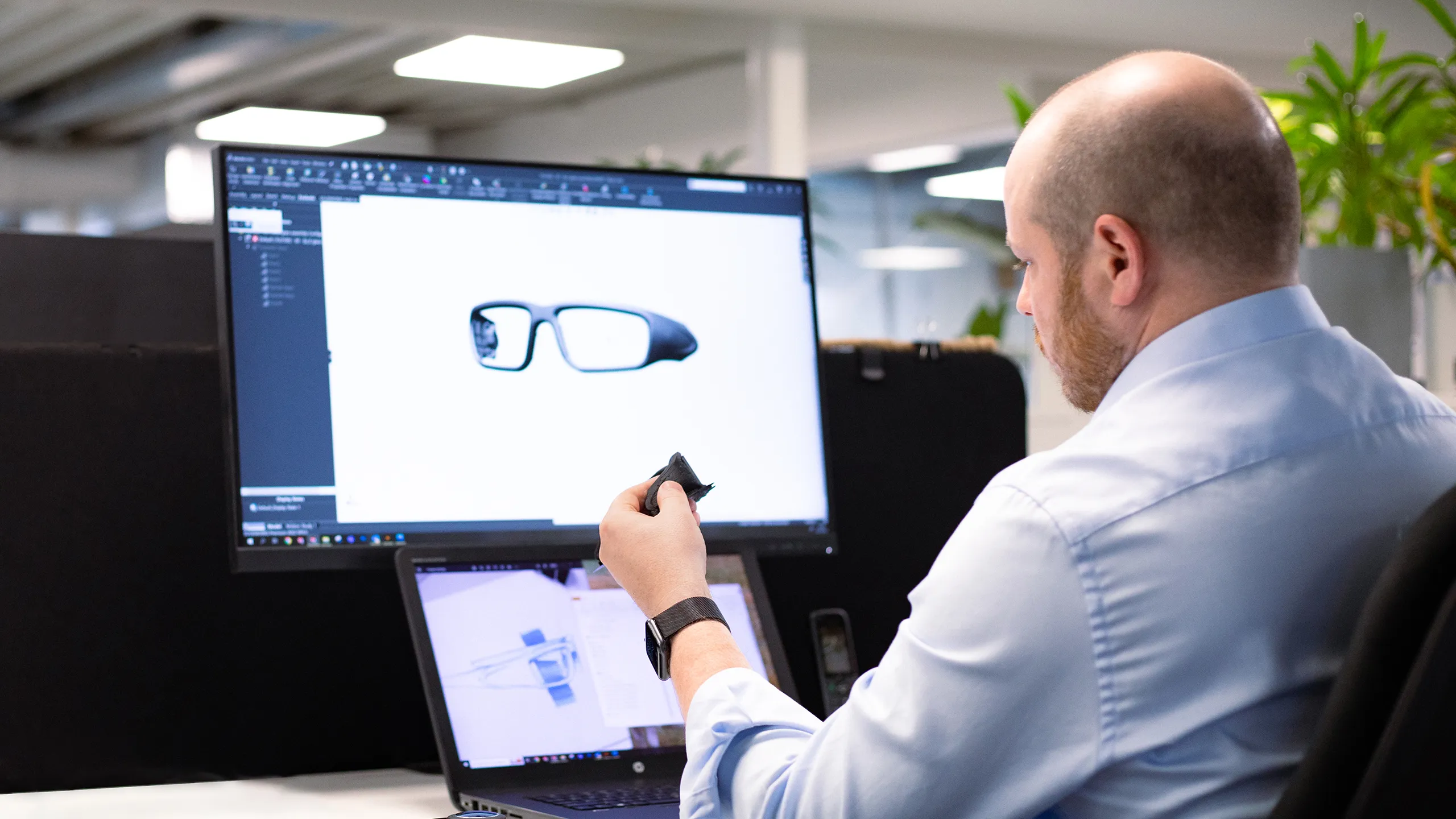
Bij het Elektronisch productontwerp draait alles om precisie – zeker als het gaat om de inpassing van componenten en het PCB design binnen de behuizing. De ruimte is vaak beperkt, en elk detail telt. Het ontwerp mag niet lijden onder technische beperkingen, en omgekeerd moeten functionele eisen perfect aansluiten bij het industrieel ontwerp. Om dit te realiseren, werken we met nauwkeurige CAD-data van leveranciers en schatten we de afmetingen van maatwerkonderdelen in op basis van input van de elektronica-ingenieurs. Al deze onderdelen worden vervolgens door ons team verwerkt in een gedetailleerd 3D-model, waarin we de optimale lay-out voor componenten en printplaten zorgvuldig rangschikken. Naast digitale modellen maken we soms ook fysieke 3D geprinte mock-ups. Hiermee toetsen we snel of een bepaalde lay-out in de praktijk goed te assembleren is – een simpele maar doeltreffende validatiemethode. Zowel de 3D-modellen als de mock-ups vormen de basis voor inhoudelijke overleggen tussen ontwerpers en elektronica ontwikkelaars en opdrachtgever. Belangrijke aandachtspunten in deze fase zijn onder andere warmteafvoer, strategische plaatsing van montagepunten, het PCBA design, elektrische afscherming, trekontlasting en de lengte en routing van kabels. Door al vroeg in het proces met deze factoren rekening te houden, voorkomen we kostbare en tijdrovende herontwerpen later in de ontwikkeling. Dit is essentieel bij elektronisch producontwerp.
Collaboration between electronics developers and our industrial design team remains essential in the subsequent stages as well. The electronics developers are responsible for the entire hardware and software development process – from the PCB design to the firmware that controls the system. At the same time, we ensure that the PCB design, cabling, power supply and other electronic components are integrated safely, logically and aesthetically into the housing.
Once the technical engineering has been completed, the focus shifts to testing and validation using a working prototype. This is when close collaboration really proves its worth. By working closely together from the very start, electronics development and industrial design align seamlessly – which significantly reduces the likelihood of surprises at this stage.
Of course, a prototype sometimes requires a few more iterations before it fully meets all functional and user requirements. However, because we carefully go through each step, these adjustments are usually minor and manageable. In this way, we work purposefully towards a reliable, manufacturable and attractive end product.
When developing an electronic product, choosing the right electronics is one of the most critical decisions in the process. This choice affects not only the technical design of the product, but also the development budget, lead time, final production costs and scalability. Broadly speaking, there are three approaches that can be considered: bespoke PCB design, the use of prototyping boards such as Raspberry Pi or Arduino, or the use of programmable logic controllers (PLCs). Each option has its own advantages and limitations, depending on the application, the type of product and the stage of development.
To make the right choice, it is important to carefully consider the required functionality, the expected production volumes, the available budget and the technical complexity. A misjudgement at this stage can lead to delays or unnecessary redesigns later in the process. GBO Innovation makers actively supports clients in making this strategic decision. Thanks to our experience in electronics development and electronic product design, we can contribute ideas at an early stage regarding the most suitable (technical) approach – one that meets both the functional requirements and the market objectives.
Voor elektronica die geschikt moet zijn voor massaproductie is maatwerk PCB design in almost all cases, the only option. A custom-designed printed circuit board offers maximum design freedom, optimal integration with the housing and a high degree of reliability. It also ensures flexibility in production and can be highly cost-effective when produced in sufficient quantities. Once the PCB design is finalised, production can be outsourced globally to specialist manufacturers. Thanks to automated production lines, the PCB design is realised at high speed and with precision at low cost. This scalability makes it particularly attractive for mass production. However, developing your own PCB is also the most complex form of electronics development. It requires in-depth engineering, precise layout planning, and intensive firmware development. This naturally entails time and investment, making a custom PCB particularly worthwhile when expected sales exceed 5,000 units per year.
However, there are exceptions. Even for smaller volumes, in-house PCB development can be the right choice – for example, for products that fulfil very specific functions or operate in high-margin markets, such as medical equipment or industrial instrumentation. GBO Innovation makers supports companies throughout the entire PCB development process, from concept to production-ready design. In this way, we ensure a solid foundation for every electronic product that is ready for the market.
Raspberry Pi and Arduino are popular choices for prototyping, DIY projects and small-scale production. These open-source electronics are easy to programme and offer a short development time thanks to extensive software libraries and community support. However, the standard boards are less suitable for professional applications: they often lack specific functionalities or contain unnecessary components that increase the cost and energy consumption. They also fall short in terms of reliability and durability, making them less suitable for long-term or industrial use. Although open-source electronics reduce development costs, they almost always result in a higher unit price. That is why, at GBO Innovation makers, we advise makers to use platforms such as Arduino or Raspberry Pi only for prototypes, small batches, or when time and budget do not (yet) allow for in-house PCB development.
PLCs (Programmable Logic Controllers) are a widely used solution in industrial automation and are employed to design reliable control systems. They consist of standard electronic modules that are mounted on DIN rails, for example, and offer advanced I/O functionality for controlling processes. Thanks to their robust construction, PLCs are particularly well-suited to demanding environments such as maritime applications, offshore, manufacturing, construction and mining.
Door de modulaire opbouw zijn PLC-systemen relatief snel te configureren en programmeren, met componenten die bij diverse leveranciers verkrijgbaar zijn. Ze worden vooral aanbevolen voor toepassingen waarbij nauwkeurige, continue controle van kritieke functies vereist is. Toch zijn PLC’s minder geschikt voor massaproductie: elk systeem moet handmatig worden opgebouwd door gespecialiseerde technici, wat ze vooral interessant maakt voor dure professionele apparatuur in kleinere series. GBO heeft eerder voor Omron deze PLC ontworpen.
Een naadloze samenwerking tussen elektronica-ontwikkelaars en industrieel ontwerpers is essentieel voor het succes van elk elektronisch productontwerp. Bij GBO Innovation makers zorgen we ervoor dat techniek en design elkaar versterken – vanaf de eerste schets, het functionele prototype tot het uiteindelijke eindproduct. Wat op papier misschien een complexe combinatie lijkt, levert in de praktijk innovatieve, doordachte en visueel sterke producten op. De resultaten? Die spreken voor zich – bekijk ons portfolio en ontdek hoe wij technologie en design samenbrengen. Een perfect voorbeeld van elektronisch productontwerp is de Garage Plug van Total Safety Solutions